Car Back Catalogue | Chevrolet
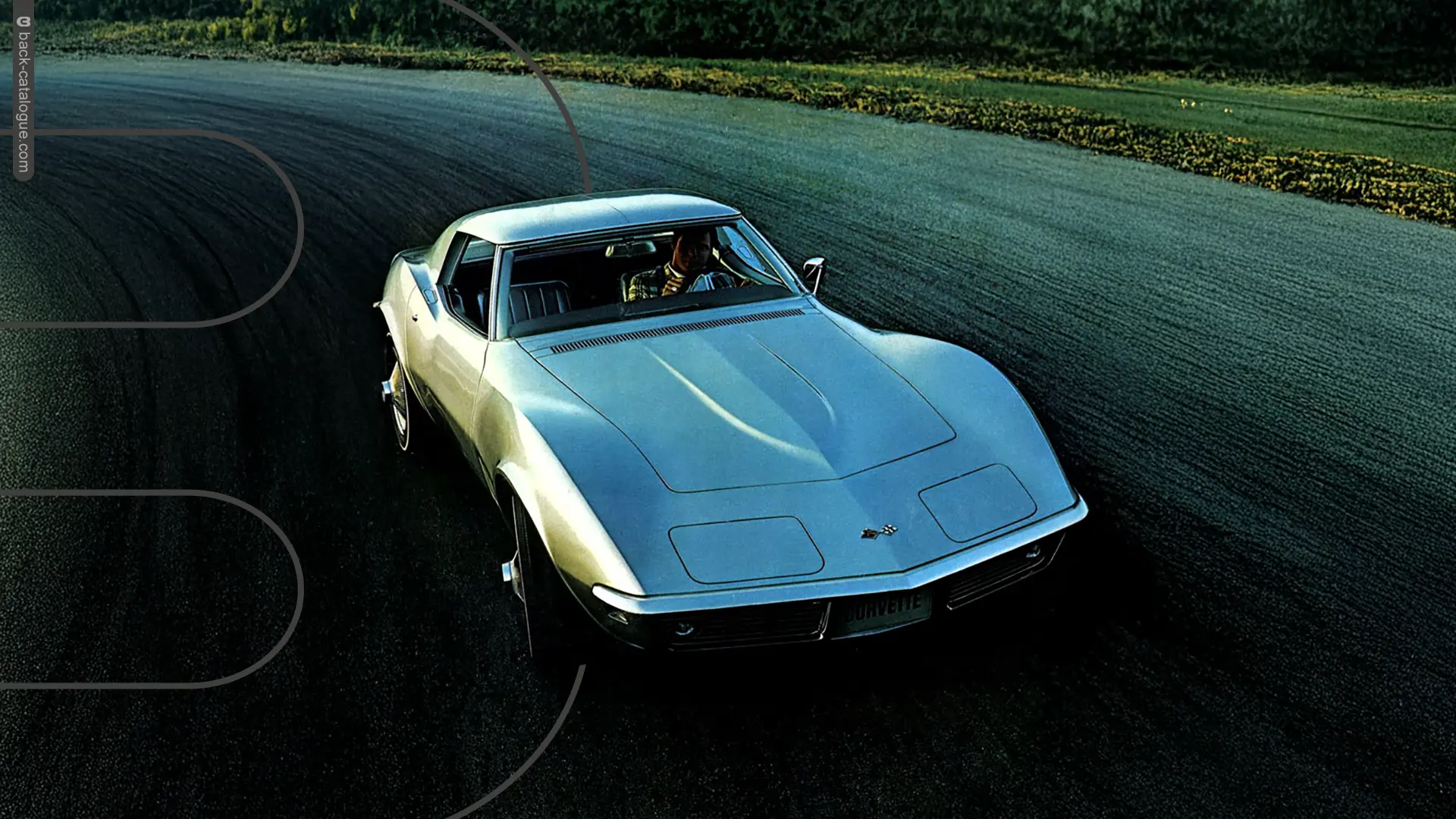
Go hardtop! The Corvette Sting Ray is for those who appreciate the true sports kind of car - and even for those who don't right now. It's that special kind of an automobile that comes along about once every generation to totally arrest the imagination of car buffs. In 15 years of Corvettes the car has not only driven into prominence in the sports car field, but has also been a forerunner of some exciting and practical automobile innovation. For 1968, the mechanics of Sting Ray have been improved and refined (it's still basically made for people who feel that the best part of living is driving), and this, obviously, is a most inspiring year for design.
Consider: the '68 Sting Ray Coupe is a hardtop and more. Uncommon removable sections over pilot and navigator lift out for open air moving. A nearly vertical glass rear window tucks out of the way into a neat compartment in the luggage area. The effect is a flow-through cochère roof that's never been seen on an American production sports car until now.
Horsepower (@ 5200)
350
Cylinders
V8
Displacement (nominal)
396
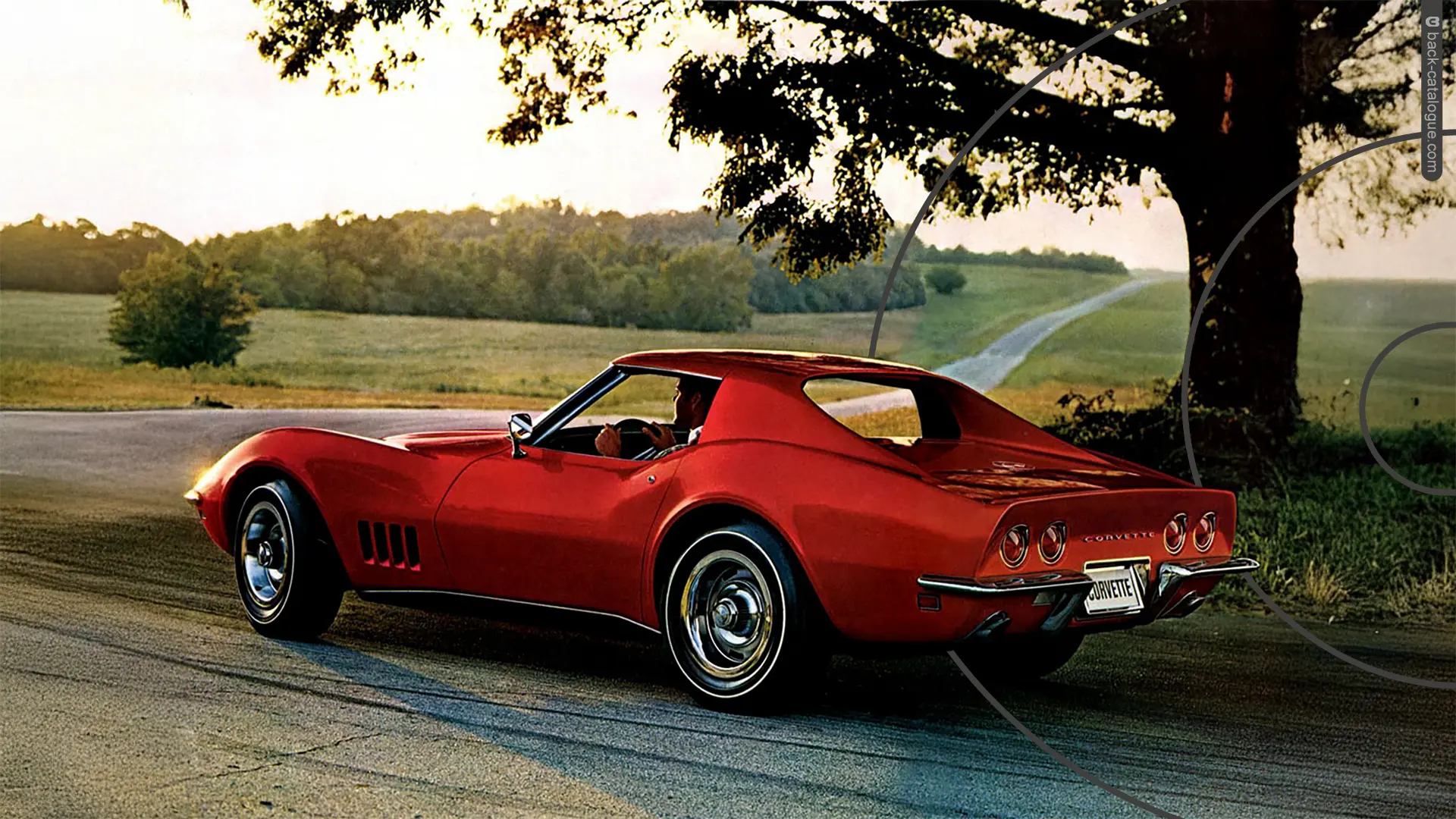
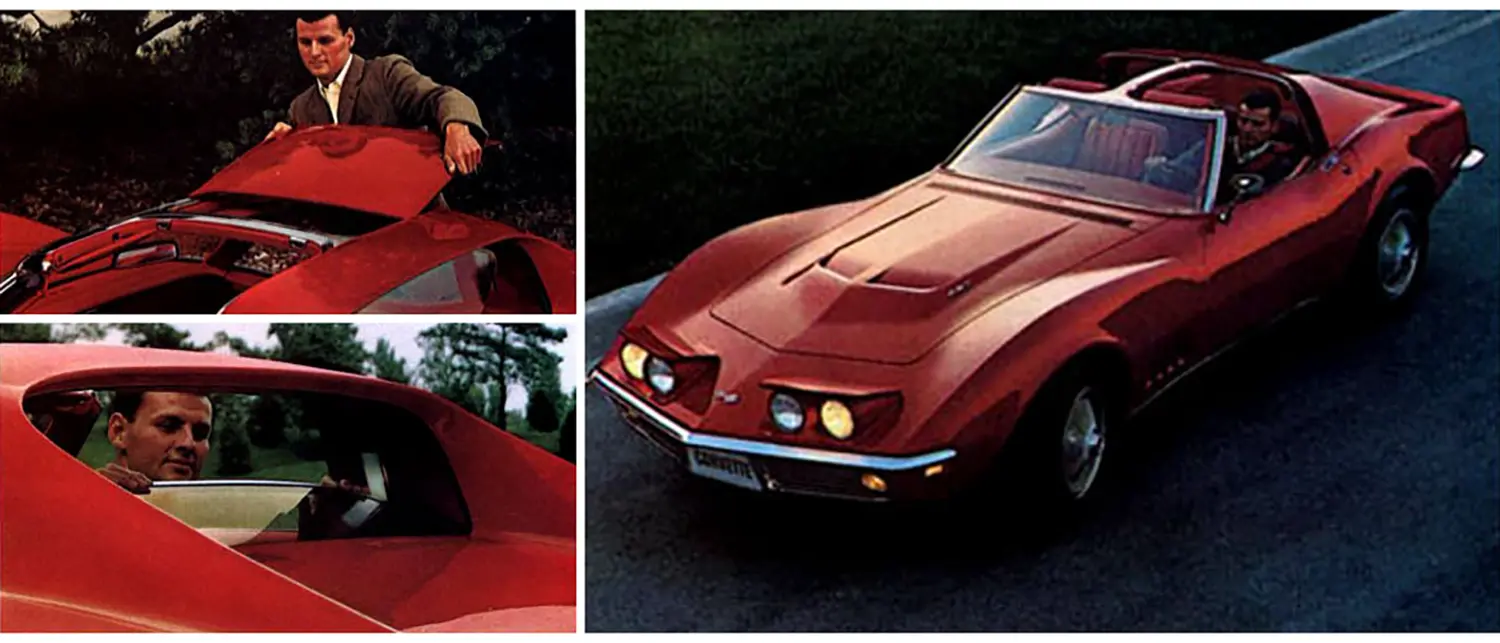
Long, low profile with blunt styling brings up the rear per the continental GT tradition. The aerodynamic design features a spoiler back there, too. Behind front wheels, functional louvers help keep the horses cool. Wraparound front and rear bumpers plus line-smoothing hideaway features help make Corvette a trim one style-wise. On the nose end, vacuum-operated headlights glide open automatically when lights are turned on. Windshield wipers aren't around when they shouldn't be. They're hidden under a power-operated panel which actuates when wipers are turned on or off. Below beltline, wheel trim rings and center caps cover big 7-inch-wide wheels. Special tuck-in treatment goes to the bright metal body sill between the wheels as you can see. Front and rear marker lights add a special touch to the Corvette from the sidelines. Corvette Sting Ray Coupe - a driving new design. Detachable glass rear window. There's a special hood for 427's.
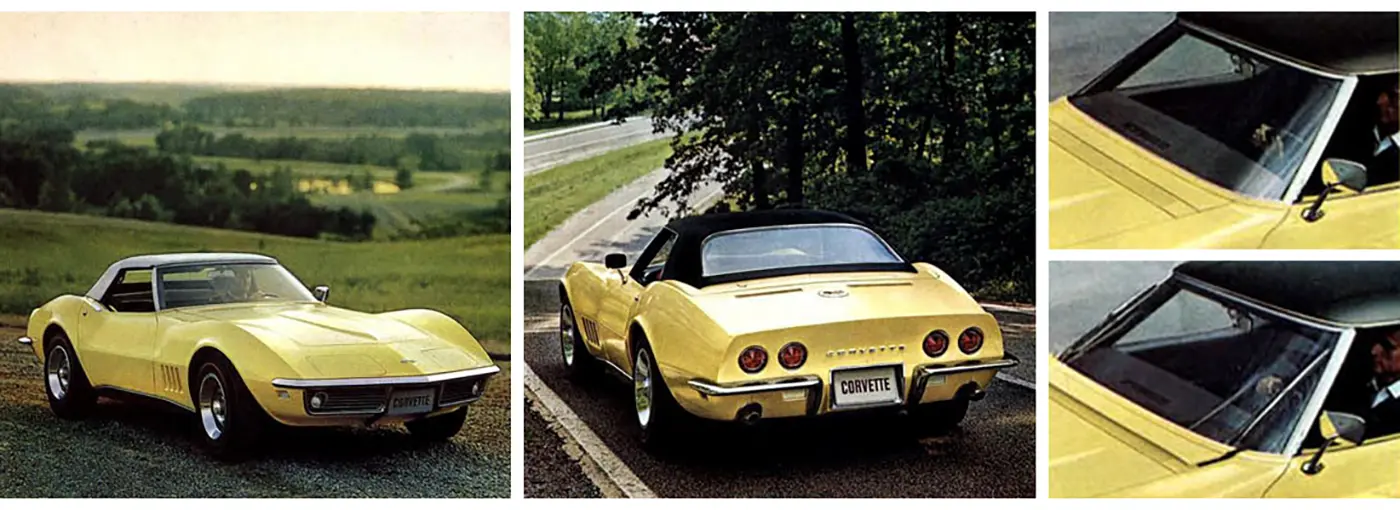
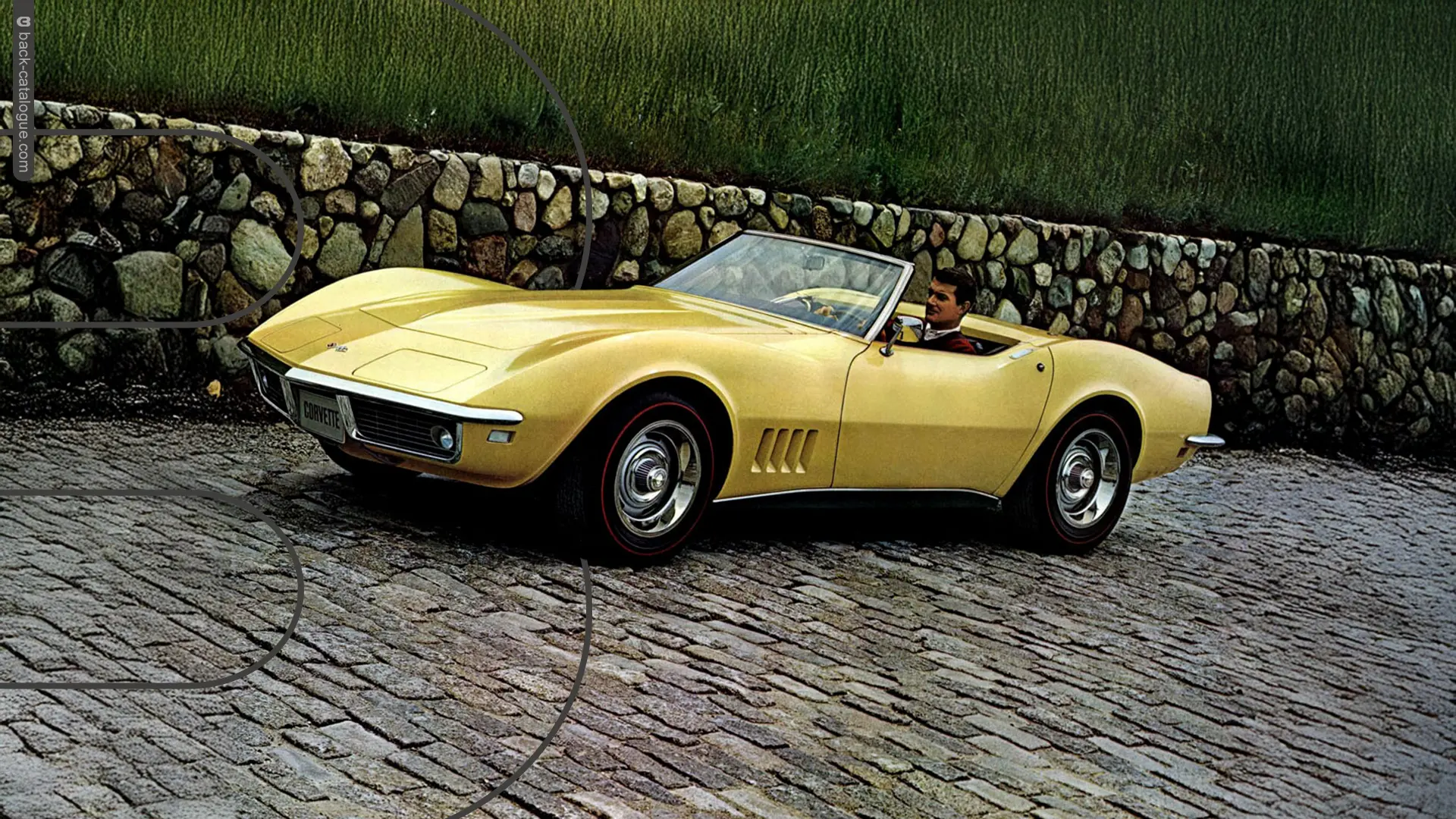
Uncap it! The Corvette Convertible takes the same basic Sting Ray idea with the lid off and turns in top- down driving for two. And there are three different ways to put the top on it. Soft top (in black, white or beige) or removable hardtop - pick either one as standard or order them together at extra cost. Black vinyl covering clads the hard one if specified. There's a big story in glass for the '68 Corvette Convertible.
Like the Coupe, and like Corvettes since '53, a rustless fiber glass body is basic. Full door glass styling aids visibility as well as appearance and the Convertible's removable hardtop has a glass rear window for the first time. The basic idea is good looks.
Both the Coupe and Convertible start off with a 300-hp Turbo-Fire 327 V8 standard along with a fully synchronized 3-Speed box. Four other engines are available, and with 427 V8's there's a special high-domed hood. Additional transmission choices are
4-Speed, close-ratio 4-Specd and Turbo Hydra-Matic - which breaks into the Corvette power team lineup this year.
For comfort, air flows through Corvette with full door windows closed. thanks to the new Astro Ventilation system with vent-ports in the driver and passenger sides of the instrument panel.
For protection, there are safety features like never before (some are listed on page 11). For long-lasting good looks, choose from ten Magic-Mirror finishes. Corvette 68 ... all aifferent all over. Corvette Convertible with folding soft top. Convertible with vinyl covered removable hardtop you can order. Hide-A-Way windshield wiper-washer system closed... and open.
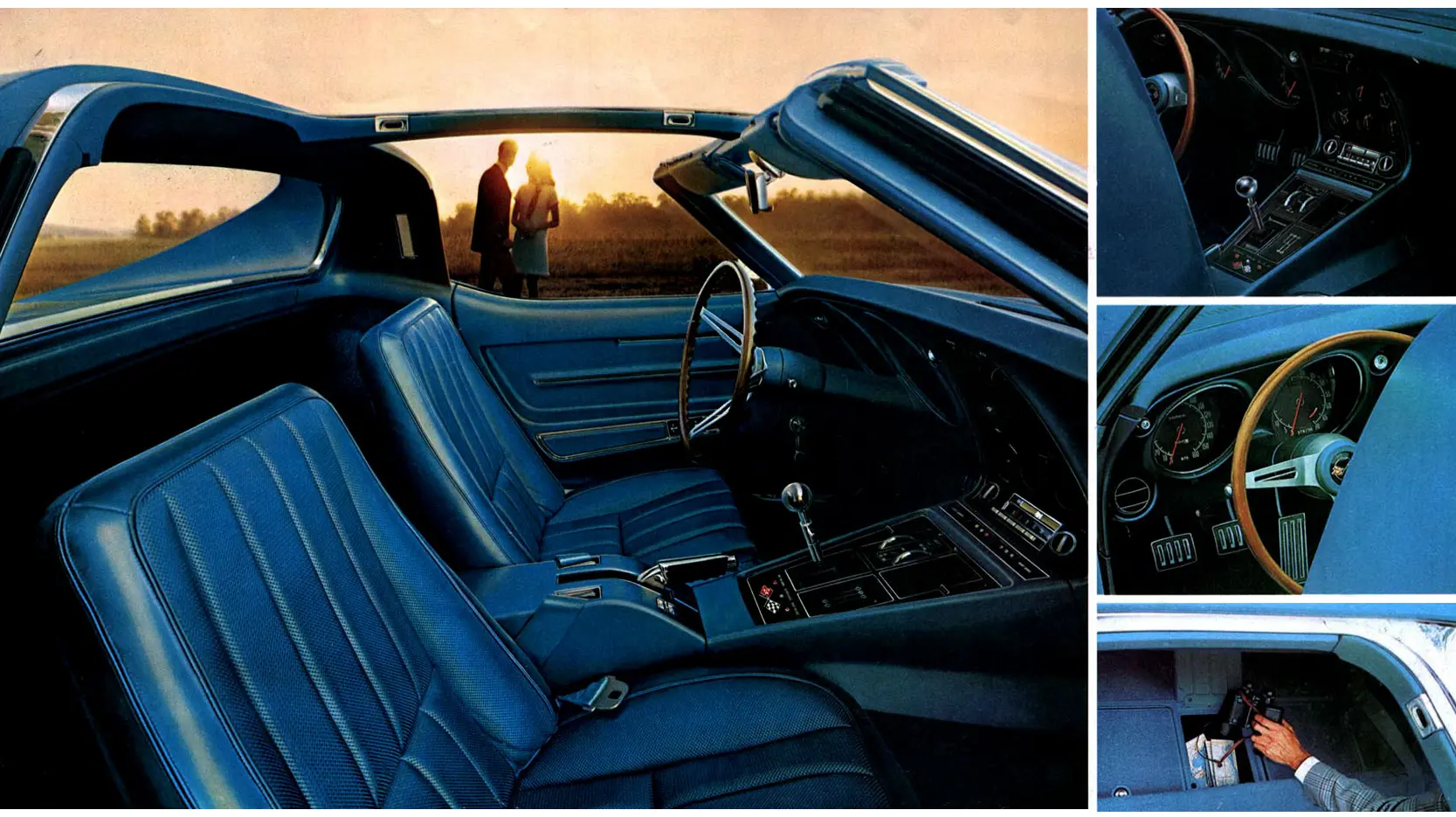
Settle down! The Corvette cockpit is made for the traveling duo. Thin tapered and contoured buckets are very comfortably high-backed. Supple all-vinyl upholstery is standard, or you can order genuine leather. Between the seats the center console houses the parking brake lever, gear shift, cigarette lighter and ashtray, thumb-wheel heater controls, air vent controls, and light monitoring system indicators (to check operation of important outside running lights from inside through space-age fiber optics). The console also stows seat belt buckle straps-twin sets with pushbutton buckles are standard. Coupe equipment also includes twin shoulder belts Riding just above the console is the recessed instrument cluster.
also in console. And if vou order an AM/FM radio-available with or without FM Stereo multiplex-controls are mounted here hori-zontally. Joining in are new features like door ajar flasher and seat belt reminder light. Directly in front of the driver are the speedometer, tachometer, trip odometer, light controls, ignition lock, high beam indicator, turn signal indicator, brake system warning light-and a 3-spoke steering wheel that looks like wood.
Luxurious deep-twist carpeting looks and feels great. It evenfloors the luggage area behind the seats. Also back there is a stowage area housing the battery, one for the jack and tools and a glove box with pushbutton key lock.
There's a great deal more to like inside Corvette. One small example is a new ignition alarm system to remind you to take the key when you leave the car. It's activated when driver's door is opened with the key in "accessory" or "off" ignition position. The Corvette interior... most luxurious and sporty ever. Corvette Sting Ray Coupe interior with high-back slim-tapered bucket seats. A center console is standard. Corvette simulated wood steering wheel and instrumentation. Three section stowage compartment behind the seats.

Take control! a part of Corvette. Frame, chassis and power team members give the enthusiast precise handling of a smooth-but-hustling road car.
Body A network of steel is integrated with body panels for increased rigidity and strength. The fiber glass body parts are bonded directly to the steel frame rather than to riveted bonding strips as in the past. Both the Sting Ray Coupe and Convertible bodies are given extra strength through increased supports and support reinforcements.
Frame All-welded, full-length, ladder-constructed with five crossmembers. Side rails and intermediate crossmembers box section; front crossmember box girder section. Eight body mounting points plus two radiator mounts.
Suspension In front, independent type with coil springs and concentric shock absorbers. Spherically jointed steering knuckles for each wheel. Reinforced stamped steel control arms with pre-loaded, steel-encased rubber bushings at pivots. Double-acting hydraulic shock absorbers with 1" piston diam-eter. Link-type stabilizer bar of steel with rubber bushings. Anti-dive control is achieved through the angle of front upper control arm. Rear suspension is fully independent with frame-anchored differential. Locus of each wheel is established by three links: universal-jointed axle shaft, adjacent strut, and a torque control arm pivoted at frame side rail. Vertical suspension loads taken by shock absorbers and transversely positioned nine-leaf spring.
Rear Axle Semi-floating straddle-mounted hypoid gear with 3.7-pint capacity. MPH in final drive with various rear axle ratios per 1000 pm: 2.73-28.6; 3.08-25.4; 3.36-23.3; 3.55-22.0; 3.70-21.1; and 4.11-19.0 (these figures are calculated for new F-70-15 wide-oval tires without allowance for tire slippage or expansion).
Steering Semi-reversible, recirculating ball-nut steering gear with GM-developed energy absorbing column. Steering damper between frame and relay rod mounted on the tie rod. Dual-mounting steering arm tie rod connection permits a choice between street or fast ratio. Turning diameter curb to curb - 39.9 ft. Number of turns lock to lock with street steering - 3.4; fast - 2.92. Power steering is a pump-powered hydraulic cylinder assisting the parallelogram linkage. Number of turns lock to lock with power steering - 2.92.
Brakes First American production car to use disc brakes at all four wheels. Dual circuit master cylinder with warning light. Braking effort is distributed 65% to front and 35% to rear. Construction is cast iron caliper type with radial cavities for heat dissipation. Sweep area is 461.2 square inches. Linings are woven asbestos; gross lining area is 81.7 square inches. Parking brake is mechanically operated on rear wheels separate from service brake system. Drum diameter of parking brake is 6.5". Linings consist of two shoes per rear wheel with gross lining area of 33.9 square inches. If you like, power brakes with new tandem diaphragm vacuum unit may be specified to lessen the required amount of pedal pressure.
Engines All Corvette engines use cast iron alloy cylinder blocks. Full-length water jackets surround each cylinder for optimum cooling. Cylinder heads are high chrome cast iron alloy. Total combustion chamber vol-umes, piston top center, are: 300-hp-4.69-cu.-in.; 350-hp - 4.17-cu.-in.; 390-and 400-hp - 5.90-cu.-in.;and 435-hp-4.92-cu.-in. Inlet manifold on 350-hp engines is of cast iron alloy. With 390-, 400- and 435-hp, inlet manifold is of cast aluminum alloy. Exhaust manifolds on all engines are cast iron alloy. The 327 engines utilize dual 4-port exhaust flow to a single outlet runner at the center; 427s use dual 4-port extended runners from each port converging to a rear outlet. Rugged alloy steel crankshaft with five main bearings in all engines (specially hardened journals and special main bearing caps with four bolt attachment per cap in 435-hp version). Crank arm length: 327-1.625;427-1.88. There are 6 counterweights on all cranks. Rubber mounted inertia torsional damper. Steel sprocket and chain timing gear. Camshaft in all engines is cast iron alloy with 5 steel-backed babbitt bearings. Valve train in each engine includes stamped individually mounted overhead rocker arms. push rods actuated with hydraulic lifters (except the 435-hp which has solid lifters). Intake valves are steel alloy. Overall head diameter of intake valves in 300-hp engine is 1.935-1.945; 350-hp-2.017-2.023; 390- and 400-hp mills -2.060-2.070; and 2.185-2.195 in the 435-hp. Exhaust valves are of steel alloy. Head diameters: 300-hp-1.495-1.505; 350-hp - 1.595-1.605; and 1.715-1.725 in all the 427 engines. Rochester 4-barrel downdraft carburetors are used in the 300-, 350- and 390-hp engines while the 400- and 435-hp power plants utilize a Holley triple 2-barrel downdraft system. All Corvette engines in 68 feature Air Injection Reactor equipment to control exhaust emission.
Fuel Pump A vapor return line for 300-, 350- and 390-hp engines has been added for 1968.
Oil Capacity Crankcase in all 327 engines holds 4 quarts of oil; in the 427s capacity is 5 quarts. Add an extra quart when changing full-flow oil filter in either engine.
Transmissions -The standard 3-Speed transmission available only with the 300-hp engine has these gear ratios: first - 2.54:1; second-1.50:1; third 1.00:1 and reverse— 2.63:1. 4-Speed ratios are: first - 2.52:1; second - 1.88:1; third - 1.47:1; fourth - 1.00:1; reverse - 2.59:1. The special 4-Speed close-ratio transmission goes: first - 2.20:1; second - 1.64:1; third-1.27:1; fourth -1.00:1; and reverse -2.26:1. All forward gears in manual transmissions are fully synchronized. A single dry disc centrifugal clutch is used with all manual transmissions. Turbo Hydra-Matic gear ratios: first -2.48:1; second-1.48:1; third-1.00:1; and reverse-2.08:1.
Dimensions —Wheelbase-98.0". Width overall-69.2". Length overall - 182.1". Tread - front: 58.3"; rear: 59.0'. Height (loaded) overall - Coupe: 47.8": Convertible: 47.9". Curb weight - Coupe: 3210; Convertible, 3220.
Fuel Tank For the first time in Corvette, a 20-gallon plastic fuel tank. Weighs less than conventional tank and eliminates chances of rust and corrosion.
To summarize Underneath the beautiful new style of the 1968 Sting Ray are some mighty solid reasons why Corvette is considered to be one of the best engineered cars in the world. It's a tough car. Body, frame, suspension - as a unit - provide an empathy between the driver and the terrain that can't really be appreciated until you "do it" yourself. Power teams can be tailored to your inclinations. Having disc brakes all around wraps up the total Corvette package very smartly. And for this year a refined rear suspension with a lower rear roll center, plus a lower center of gravity - combined with the reduced camber effect resulting from wider 7" rims and wide-oval tires - adds to the already proven handling potential of America's only true production sports car. Outside, inside and deep down, the '68 Corvette Sting Ray is a special way to go.
| Engine bore & stroke | Hp & torque at rpm | Carb & induction | Comp ratio | Cam & lifters | Trans | Axle ratio (standard) | Axle ratio (optional) |
| Standard Engine | |||||||
| 327 cu in Turbo-Fire V8 (4.00 × 3.25) | 300 hp @ 5000 rpm 360 lb-ft @ 3400 rpm |
4-barrel High-flow |
10.0:1 | General performance Hydraulic |
3-speed (2.54:1 low) 4-speed (2.52:1 low) Turbo Hydra-Matic |
3.36:1 | 3.08:1 |
| 327 cu in Turbo-Fire V8 (4.00 × 3.25) | 360 lb-ft @ 3400 rpm | High-flow | 10.0:1 | Hydraulic | 4-speed (2.52:1 low) | 3.36:1 | 3.08:1 |
| 327 cu in Turbo-Fire V8 (4.00 × 3.25) | 360 lb-ft @ 3400 rpm | High-flow | 10.0:1 | Hydraulic | Turbo Hydra-Matic | 3.08:1 | - |
| Extra-Cost Engines | |||||||
| 327 cu in Turbo-Fire V8 (4.00 × 3.25) | 350 hp @ 5800 rpm | 4-barrel | 11.0:1 | High performance | 4-speed (2.52:1 low) | 3.36:1 | 3.08:1 |
| 327 cu in Turbo-Fire V8 (4.00 × 3.25) | 360 lb-ft @ 3600 rpm | High-flow | 11.0:1 | Hydraulic | Special 4-speed (2.20:1 low) | 3.70:1 | 4.11:1 |
| 427 cu in Turbo-Jet V8 (4.251 × 3.76) | 390 hp @ 5400 rpm | 4-barrel | 10.25:1 | High performance | 4-speed (2.52:1 low) | 3.08:1 | 3.55:1 |
| 427 cu in Turbo-Jet V8 (4.251 × 3.76) | 460 lb-ft @ 3600 rpm | High-flow | 10.25:1 | Hydraulic | Special 4-speed (2.20:1 low) | 3.36:1 | 3.36:1 3.55:1 3.70:1 |
| 427 cu in Turbo-Jet V8 (4.251 × 3.76) | 460 lb-ft @ 3600 rpm | High-flow | 10.25:1 | Hydraulic | Turbo Hydra-Matic | 3.08:1 | 3.36:1 |
| 427 cu in Turbo-Jet V8 (4.251 × 3.76) | 400 hp @ 5400 rpm | Triple 2-barrel | 10.25:1 | High performance | 4-speed (2.52:1 low) | 3.08:1 | 3.36:1 |
| 427 cu in Turbo-Jet V8 (4.251 × 3.76) | 460 lb-ft @ 3600 rpm | High-flow | 10.25:1 | Hydraulic | Special 4-speed (2.20:1 low) | 3.36:1 | 3.36:1 3.55:1 3.70:1 |
| 427 cu in Turbo-Jet V8 (4.251 × 3.76) | 460 lb-ft @ 3600 rpm | High-flow | 10.25:1 | Hydraulic | Turbo Hydra-Matic | 3.08:1 | 2.73:1 |
| 427 cu in Turbo-Jet V8 (4.251 × 3.76) | 435 hp @ 5800 rpm | Triple 2-barrel | 11.0:1 | Special performance | Special 4-speed (2.20:1 low) | 3.55:1 | 3.36:1 3.70:1 4.11:1 |
| 427 cu in Turbo-Jet V8 (4.251 × 3.76) | 460 lb-ft @ 4000 rpm | High-flow | 11.0:1 | Mechanical | Special 4-speed (2.20:1 low) | 3.55:1 | 3.36:1 3.70:1 4.11:1 |
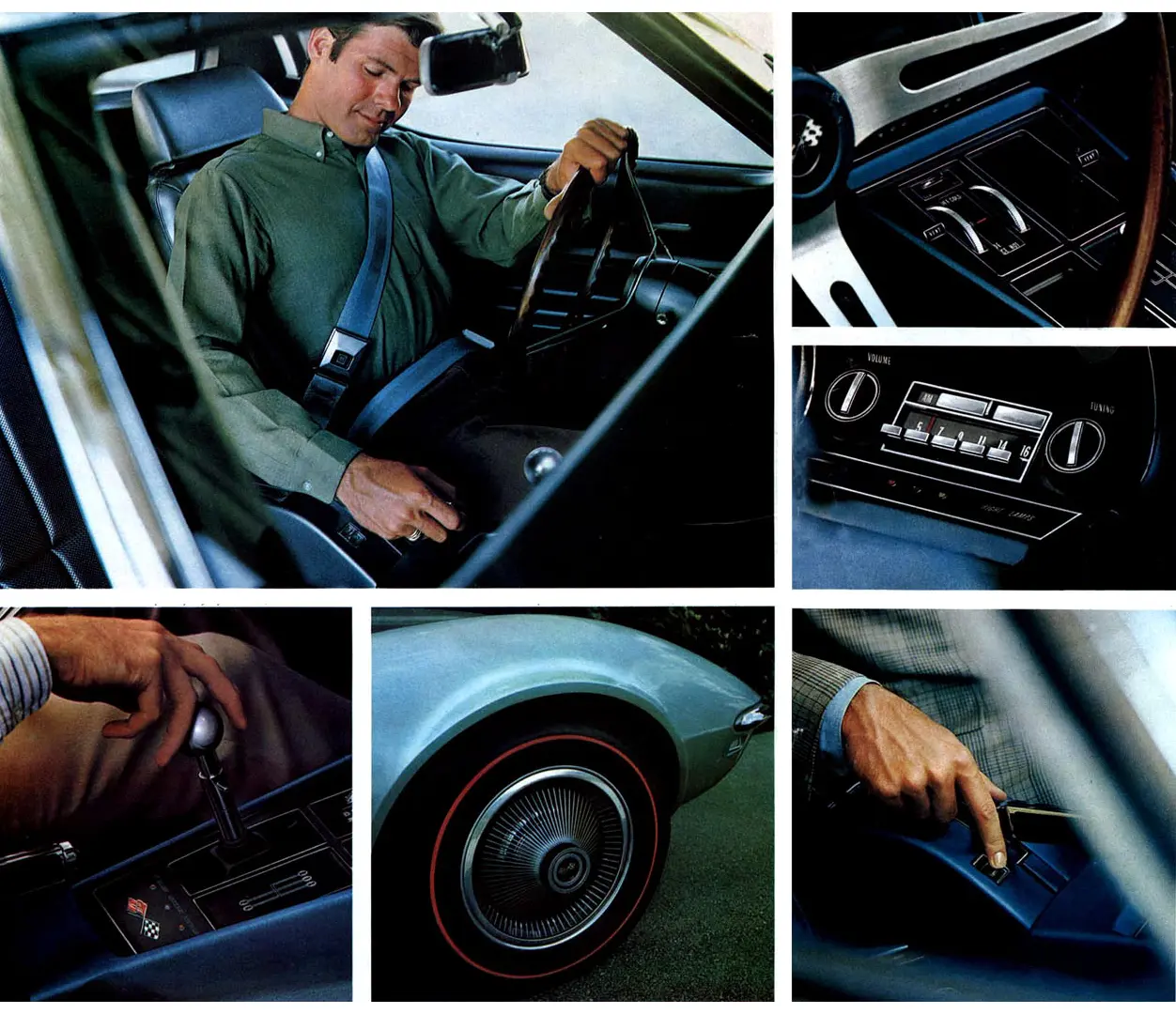
Be yourself! Corvette Options and custom features. A lot aren't needed to make Corvette driving more enthusiastic, comfortable and convenient. But, just in case - for the sports car connoisseur - here's a list of some special items that can be ordered: Aluminum cylinder heads for the 435-hp engine. Compass. Deck lid luggage carrier adds cargo capacity and sporty looks. Deck lid ski carrier. Deluxe shoulder belts for the Convertible (standard with the Coupe). Emergency road kit with fire extinguisher, tire inflator and sealer, trouble flag, two flares, assorted fuses. Optional engines: 350-hp Turbo-Fire 327 V8; 390-, 400- or 435-hp Turbo-Jet 427 V8 (Special high-domed hood is included when 427-cu.-in. engine is specified).
Fire extinguisher. Floor mats of clear vinyl to keep deep-twist carpeting looking new. Folding vinyl-coated soft top for Convertible (black is standard, beige and white available). Four-Season air conditioning, built into Corvette's heater-defroster sys-tem, cleans, dehumidifies and blends air to the temperature you desire. Full-transistor ignition system (not available with 300-hp Turbo-Fire 327 V8). Gas cap lock. Hand portable spotlight.
Strato-ease head restraints. Genuine leather seat trim. Off-road exhaust system. Positraction rear axle, on slippery or irregular surfaces, sends power to the wheel that has the most traction. Power brakes to reduce braking effort about one-third. Power steering to assist in handling corners and twisting roads. Power windows. Pushbutton AM/FM radio with twin speakers and fixed height rear antenna. Rear window defroster.
Removable hardtop for Convertible (may be specified as standard in lieu of folding convertible top). Special purpose front and rear suspension with 435-hp engine. Speed warning indicator - determine your speed limit and set control, then buzz reminds you when you exceed pre-set speed. Special bright metal wheel covers. FM Stereo multiplex. Adjustable steering column for individual driving comfort. Soft-Ray tinted window glass and/or windshield. Transmissions: 4-Speed fully synchronized (2.52:1 low); special 4-Speed fully synchronized close-ratio (2:20:1 low); Turbo Hydra-Matic which operates automatically unless you want to shift it - through three forward gears up to 65 mph.
Black vinyl covering for removable hardtop. Visor vanity mirror. Nylon cord wide-oval red stripe or white stripe tires. Strato-ease head restraints (optional) and shoulder belts (standard with Coupe). Four-Season air conditioning. AM/FM radio. Power windows. 4-Speed fully synchronized transmission. Special wheel covers and nylon red-stripe tires.
Safety Features Standard for the 1968 Corvette: Energy-absorbing steering column; Seat belts with pushbutton buckles for driver and passenger positions; Shoulder belts for driver and passenger with pushbutton buckles and convenient stowage provision on the Coupe; Passenger-guard door locks; Four-way hazard warning flasher; Dual master cylinder brake system with warning light and corrosion-resistant brake lines; Latches on folding seat backs; Dual-speed windshield wipers and washer; Outside rearview mirror; Back-up lights; New side marker lights and parking lights that illuminate with headlights; Padded instrument panel, sun visors, windshield pillars; Reduced-glare instrument panel top, inside windshield moldings, horn button, steering wheel hub, and windshield wiper arms and blades; Inside day-night mirror with deflecting base: Lane-change feature in direction signal control; Safety armrests; Thick-laminate windshield: Soft. low-profile window control knobs: Yielding window control han-dles; Energy-absorbing instrument panel; Tire safety rim; Safety door latches and hinges; Uniform shift quadrant; Snag-resistant steering wheel hardware; Fuel tank and filler pipe security.
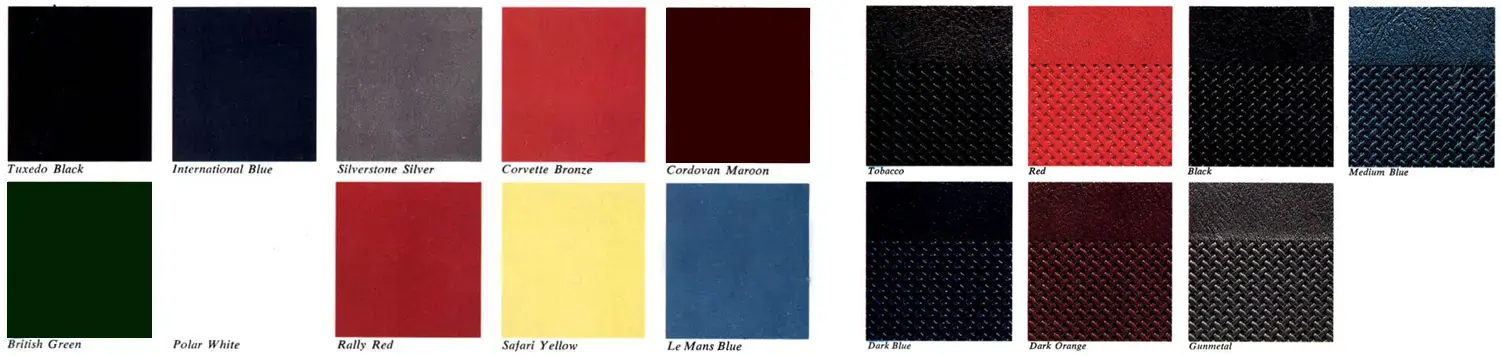
Here's a tough one. Try to select just one of these ten luxurious Magic-Mirror colors. Eight of them are brand new. (Tuxedo Black and Rally Red are popular choices we kept from last year's selection.) The fabric top for the Convertible can be specified in black, white or beige. You can also order a black vinyl cover for the removable hardtop.
One more decision. Try to settle on the one colour you like best from this excellent selection. Interiors are color-keyed to exterior colors with deep-twist carpeting also hued to match. The textured vinyl looks like leather, but if you like, genuine hide can be ordered in black, red, medium blue, dark orange or tobacco.